
Knit Bust Darts: When and how to add bust darts to your handknit sweater or top
This post is a companion to my new video all about bust darts! If you’re more of a reader than a watcher, this is for you!
What are knit bust darts?
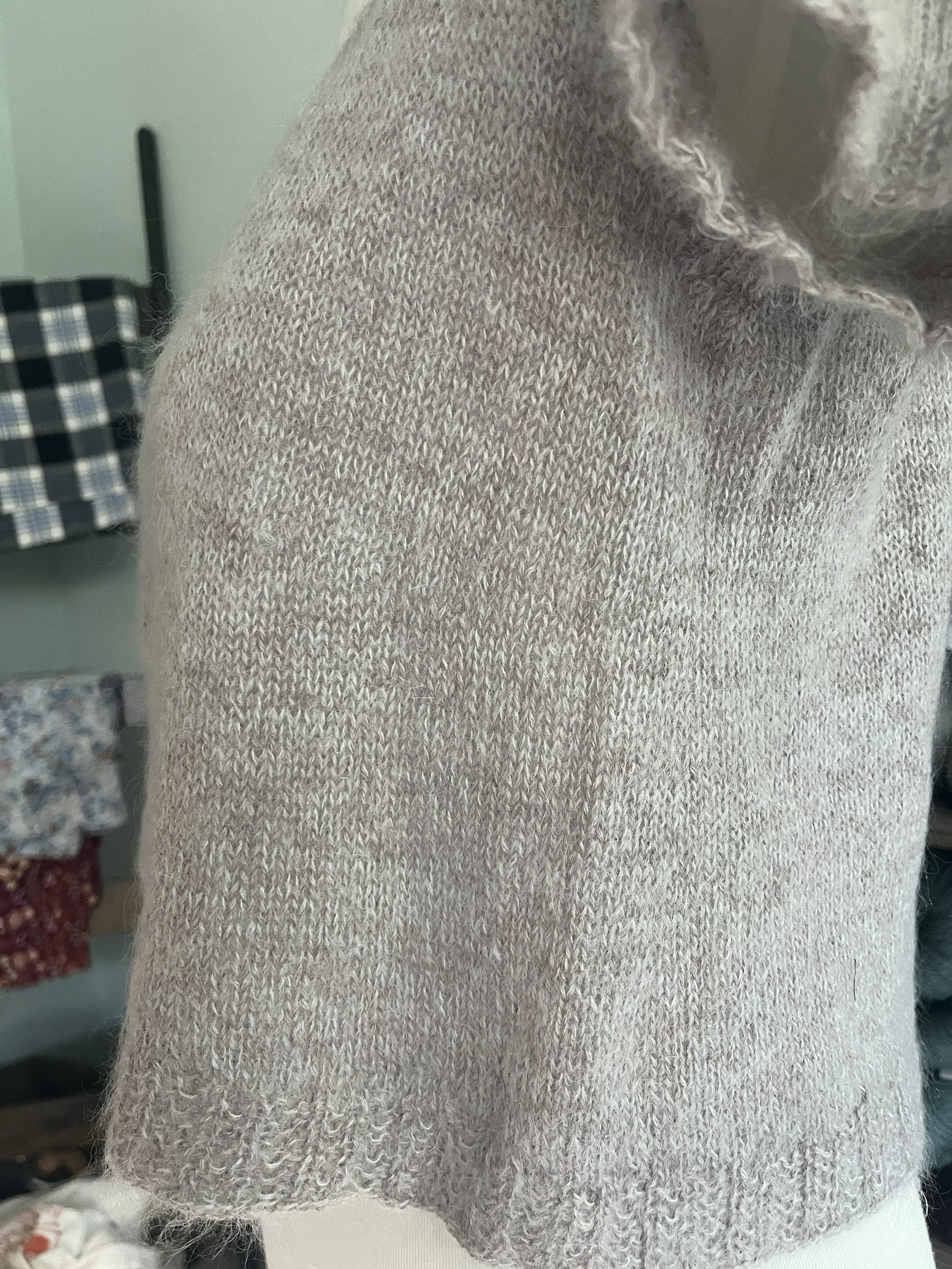
Horizontal bust dart
Blends fairly seamlessly into the fabric
In simple language, bust darts are fabric added into the front of a garment to make room for your boobs. In this post I’m specifically going to be talking about horizontal bust darts, which add length to the front of your garment by creating a wedge of additional fabric below the bust. Though knit, and especially stockinette fabric, is stretchy, without this additional fabric, larger breasts will stretch the fabric so far apart and out that the remaining fabric below will begin to curve upward.
Briefly, vertical bust darts also exist; these add width, rather than length in the bust area—think of princess seams in a sewn blouse. These are less common and personally I find them less intuitive, so we’ll save them for another day.
Does your sweater need bust darts?
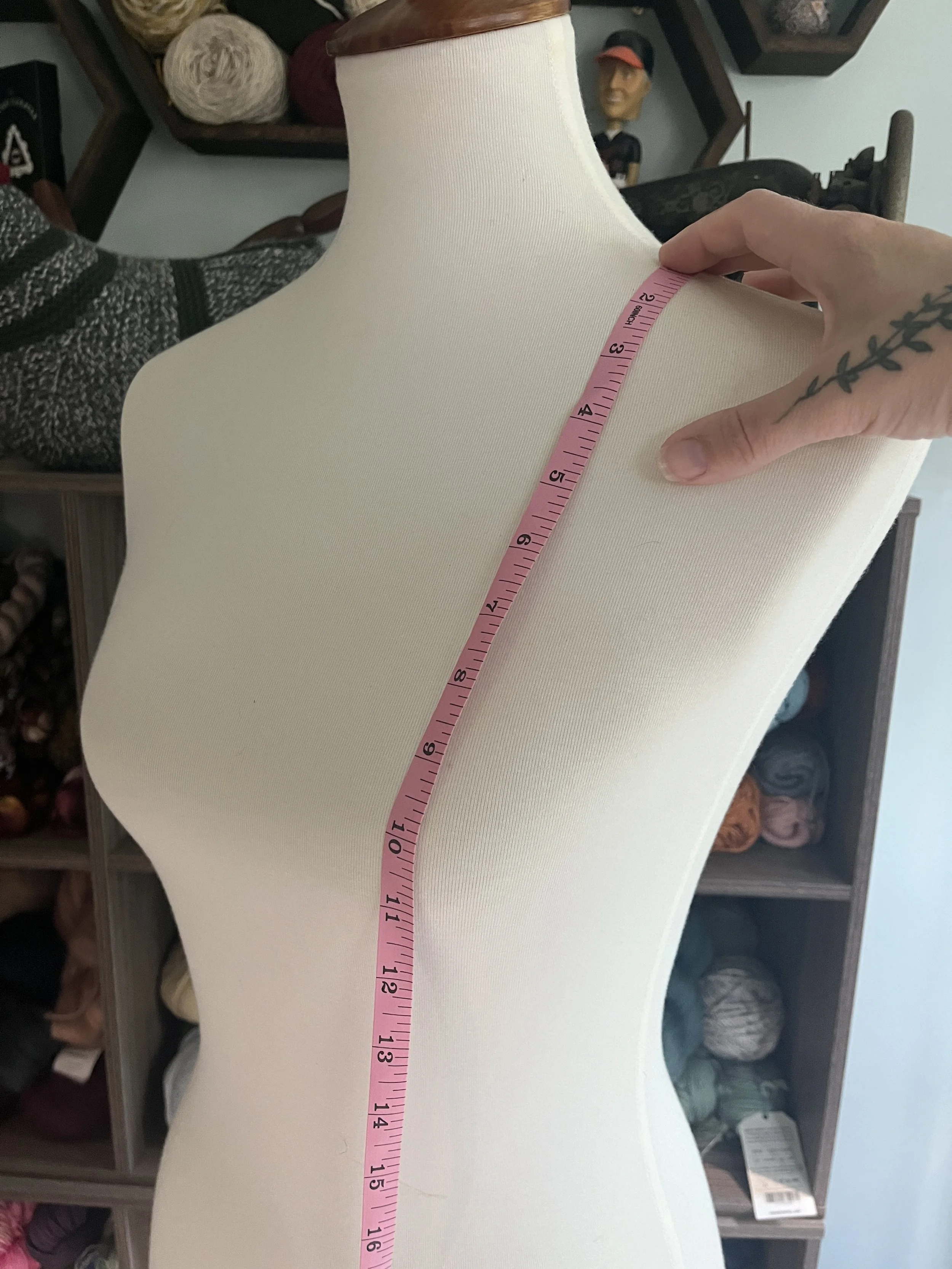
Measuring
Careful measurements will ensure an accurate fit
There are no hard and fast rules about who needs bust darts. Some people simply learn from experience—their sweaters ride up in the front.
There are, however, several body measurements you can take that might offer guidance. Some designers suggest that if the difference between your high bust and full bust is more than 2”, you should add bust darts, for example.
I will be referecning Aimee Sher’s guidelines, which essentially have you measure the front and back length from neck to underbust; if the difference is more than 2” she recommends bust darts.
Why 2”? Because knit fabric stretches and most garments will stretch enough to accommodate this relatively minor difference without significantly impacting the garment length.
It’s also worth noting that your yarn composition, tension of your fabric, and ease of your garment will impact fit. Wool is a more elastic fiber than cotton, so an oversized, boxy wool sweater, especially one knit at a loose gauge, generally doesn’t need added darts until the difference is larger. On the other hand, in a closer fitting garment, worked at a tighter gauge, there is less extra fabric in the front to accommodate your breasts and less natural stretch, so you may need bust darts even with less than a 2” difference between those measurements.
How do bust darts impact the size you should knit?
If you’re adding bust darts, will that impact the size you should knit? Maybe.
This is a difficult question to answer because it really depends on a number of factors. As always, you should be looking at all of the measurements provided in the schematic; if all the other measurements for a size 2 would fit you, but you need to knit a size 5 just to accommodate your full bust circumference then in that case, yes, adding bust darts should allow you to size down.
However, for most patterns, the difference between sizes is already about 4”, so you would likely need a fairly substantial difference between your upper bust and full bust to warrant a size change.
How do you place and calculate bust darts?
When working from the top down, short rows for bust darts should begin just past the fullest part of your bust, with the width of the shortest row slightly wider than the points (aka, nipples) of your bust line. The idea is not to get the points of the darts directly over the center of each breast but rather just below and to the outside.
Working top down is ideal because you can try your garment on to get the right spot. If possible, work the collar and sleeves first, as they will pull the yoke of your sweater in and alter the fit, and consider doing a mid-project block to make sure your in-progress garment is fitting as much like the finished project as possible.
Also be sure you’re wearing whatever kind of support garments you would usually wear with your sweater or top when measuring and trying on; bra, bralette, etc. The shape and height of your breasts will be different when you’re not wearing support garments.
Bust darts can also be added working bottom up, starting with the longest row and working toward the fullest part of the bust, but it’s worth noting, getting the placement right is trickier.
Once you’ve reached the point of your project where you want to begin bust shaping, you’ll need to do some MATH. These calculations from Heather Storta are very comprehensive, but I’ll summarize them here. (Make sure you’re using your blocked gauge.)
Difference between your measurements - 2” for natural stretch = length of dart.
Inches between points of breasts +1.5” [3/4” ea side] * stitches per inch = number of sts in your shortest row (even if your front st count is even; odd if it’s odd)
Total front stitches – 2” worth of stitches (1 inch per side) = sts in longest row
(Longest row – shortest row)/2 = sts on either side to work short rows over
Length of dart * rows/rnds per inch = number of total rows in dart (even)
(Sts on either side – number of wrapped or double sts)/number of short rows on each side = sts between short row turns
This is, of course, wildly easier if your garment is knit in stockinette; working short rows while maintaining a stitch pattern—let alone ensuring you do not disrupt the repeats lengthwise—is a significant challenge.
Reference: Pi Camisole
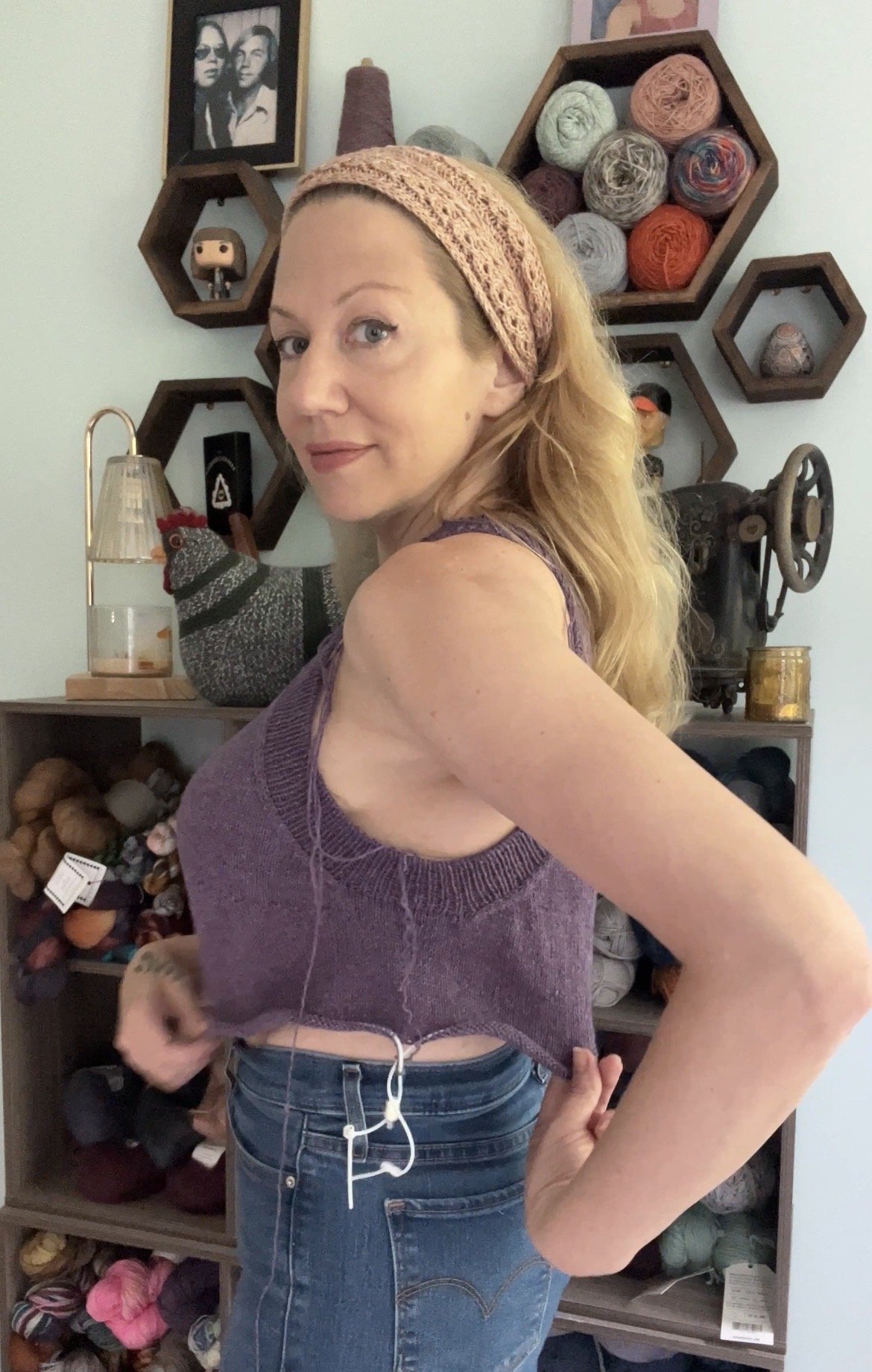
Pi Camisole
Added bust darts keep front and back length even
I recently added bust darts to my Pi Camisole. This is a quick review of my measurements and calculations:
The difference between my front and back measurements as described by Aimee Sher was 3” (fwiw, about the same as difference between high bust and full bust); because this is a close-fitting garment, I only subtracted 1” rather than the recommended 2”, because there’s less horizontal stretch available to work with; meaning I need a bust dart length of 2”, which, at my gauge is 22 rows or 11 pairs of short rows
The width of my shortest row needs to be 8.5”, or 68 sts, and the longest should be 124 sts.
Short rows will be worked over 28 sts on each side; (28 sts – 11 turning sts)/11 = ~ 1.5 sts between each turn.
Should all knitting garment patterns include optional bust darts?
IMO, it might be nice but it’s not absolutely necessary. One, because it doesn’t make sense for designers to add lots of instructions and calculations for bust darts that either aren’t needed or won’t work for many people, because boobs are frankly, too unique.
In addition, most pattern designers are already not earning any kind of living wage from their work, and a persistent segment of the knitting community is already complaining that patterns have gotten too expensive. We can’t expect designers to keep adding more and more to their patterns for the same poor wage.
Personally, in generaI think knitters should take ownership of learning to knit garments that fit their own boobs, and the rest of their bodies, because, while it will take some trial and error, learning to calculate darts that fit your body will cause much less frustration in the long run than trying to use instructions calculated for averages—which is the reason garment fit issues exist in the first place. Designers simply cannot write instructions that will fit absolutely every body. Every part of a garment design is based on averages, and it’s up to us, in the end, to learn to adjust for our own unique shape.
It’s great that some designers include guidelines for making these adjustments, and in non-stockinette garments it’s incredibly valuable, but it would ultimately be more practical for knitters to build a set of skills that would help them adjust any pattern, rather than doing it piecemeal.